AR Digital Signage: Real Deployment Formats and Examples
Three AR signage formats we have actually deployed — a screen-first photo experience in a Prague mall, a city-wide championship activation and a QR-to-app fan experience — and how to tell which one a venue needs.
What AR signage looks like once it is installed
Most writing about augmented reality on digital signage stops at the definition. The useful distinction is not what AR is, but which shape it takes on site — because the shape determines what you install, what the visitor does, and where the resulting image ends up.
Three of our projects sit in three different shapes: an AR photo experience built into the screen itself at Quadrio Mall in Prague, a city-wide fan activation for the Ice Hockey World Championship 2024, and a companion-app experience for Fortuna League where the signage starts the interaction but the phone finishes it. Everything below comes from those deployments; the commercial overview is on the AR digital signage page.
Format one: the screen-first AR photo experience
At Quadrio Mall in Prague the whole experience lives in the signage unit. It is a high-resolution display with a camera facing the space in front of it, running our AR photo application.
The live camera image is the backdrop. The application places a Franz Kafka figure into that view in whichever pose the visitor picks — from straightforward to deliberately absurd — and captures the frame. The visitor then shares the photo on social media through the app, so the picture leaves with them rather than sitting on a mall screen. Nothing is worn, scanned or installed.
The design decision worth copying is the step count. The screen stands in a passage, so the interface was cut to the minimum: people start, pose, capture and leave without anyone explaining it. The rationale for building an AR version of a statue people can already photograph is the same rationale: a photo of the statue is a photo of the statue, but in AR the visitor chooses the pose, so the result is their picture and not the landmark shot everyone else takes.
Format two: the event-scale fan activation
For the Ice Hockey World Championship 2024 the same screen-first principle was applied at event scale across Prague. Large-format digital signage at locations across the city ran our AR application, which composites a processed hockey legend over the live camera image in real time so fans can take a photo or a short video with them. No app, no headset.
What makes this format different is not the screen, it is the content pipeline behind it. Each player had to be captured in a controlled studio session and processed into a figure that still reads as that specific player at full scale, because an AR figure standing beside a fan is judged against the person next to it. Capture quality, proportions and how the figure is grounded in the frame matter more than any on-screen effect — and getting that right in the studio is what keeps the signage side simple. We describe that production work in the athlete capture write-up.
The deployment lesson: this format multiplies well. Because the intelligence is in the content and the application, the same experience could stand at several locations in the city rather than in a single fan zone.
Format three: signage that hands off to a companion app
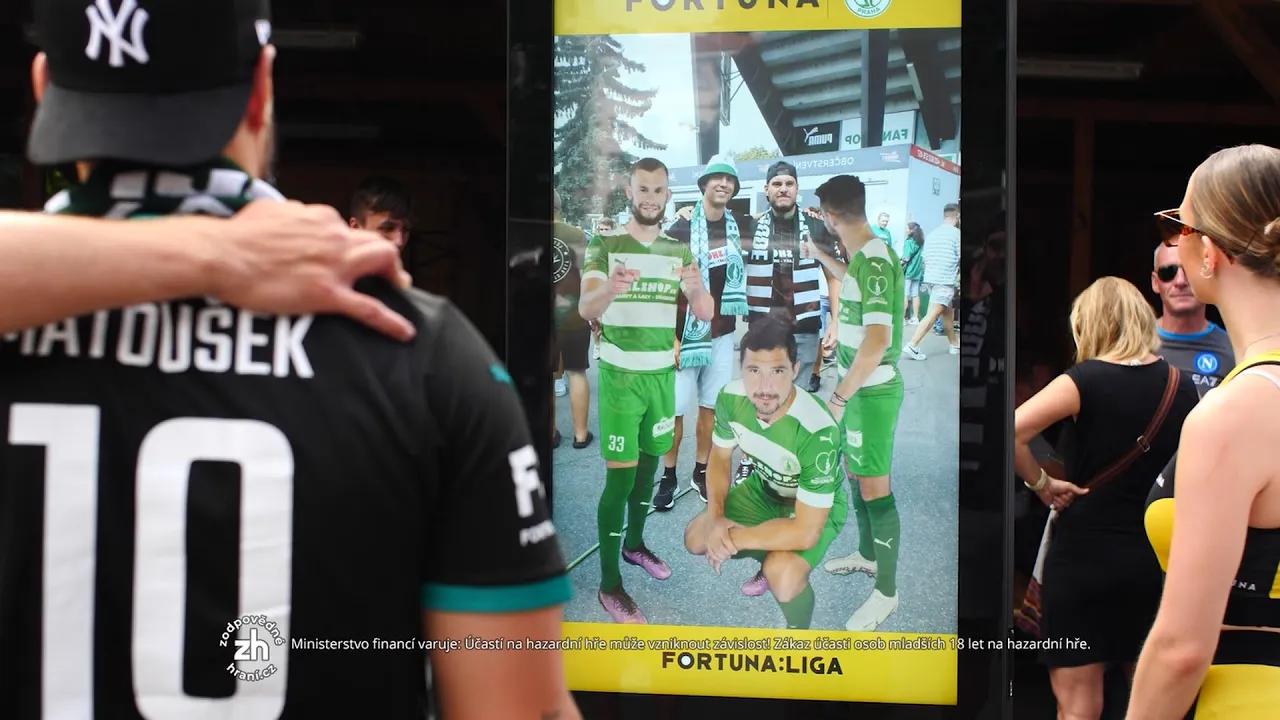
The Fortuna League activation inverts the arrangement. Three pieces make it up: digital signage units placed around the stadium and other key locations, a QR code on each unit that hands the fan off to the Fortuna League app, and the AR layer inside that app, which composites a virtual player into the phone's live camera view.
The fan opens the app, approaches a unit, scans its QR code to activate AR, poses with a virtual player, and shares the photo to social media from the app.
The reason to build it this way is ownership of the image. The fan already carries a camera and a social account, so capturing on the phone means the picture is theirs the moment it exists and sharing is one step instead of a printout or an email form at the screen. The operational consequence is equally real: nothing is installed at the venue beyond the signage itself, which is why the units could be spread around the stadium and other locations.
Choosing between the formats
Screen-first, as at Quadrio and the Championship, wins where the audience is unprepared. A passer-by will not download anything, but they will stand in front of a screen for fifteen seconds. It also gives you a large, visible spectacle that pulls the next person in.
App-supported, as at Fortuna, wins where the audience is already invested — a league's own fans who have a reason to hold the app — and where you want the output on the fan's device with the shortest possible path to their feed. It also keeps on-site infrastructure to the signage alone.
A few practical criteria we apply:
Venue. A mall passage argues for screen-first, because you are interrupting a walk. A stadium with a committed audience tolerates a scan.
Audience preparation. If the visitor has no prior relationship with the brand, every prerequisite you add costs you participants.
Interaction length. Screen-first experiences need to resolve quickly, since the next person is waiting in the same physical spot.
Where the output must land. If sharing is the objective, the app route makes it native. If presence and spectacle are the objective, the big screen does more work.
For the photo-output variants specifically, see the AR photo booth format and how it plays out at sports events; for the sector context, our sports and entertainment work covers both the Championship and the league activation.
Frequently asked questions
Do visitors need an app for AR digital signage?
It depends on the format. At Quadrio Mall and at the Ice Hockey World Championship the AR runs in the signage application itself with nothing to install. The Fortuna League experience deliberately uses a companion app, activated by scanning a QR code on the signage unit.
What is installed on site?
For screen-first formats: a digital signage display with a camera facing the space in front of it, running the AR application. For the app-supported format, only the signage units carrying the QR code.
Can AR signage be deployed at more than one location in a campaign?
Yes. For the Ice Hockey World Championship 2024 the AR signage stood at locations across Prague, and Fortuna League units were placed around the stadium and other key locations rather than in one fan zone.
What is the hardest part of an AR signage project?
In our experience, the source material rather than the screen. A figure shown life-size next to a real person is judged against that person, so capture quality and proportions decide whether the composite is convincing.